Showing posts with label game. Show all posts

Level Design In Abstract Methodology

Saturday, February 19, 2011

0 comments
This essay reflects on many concepts that currently reside in or out of game development disciplines, but are being strung together here as an abstract and philosophical methodology when conceptualizing and constructing virtual game spaces.

Inspiration:
There's nothing like a good trip abroad to stimulate the senses into a descent towards wonder and perhaps some much needed inspiration. Strolling through the Suzhou Museum, China I began to reflect the organic and abstract approaches a notable architect will make before diving into a design. In this case it was the Chinese American architect - Ieoh Ming Pei (of the glass-and-steel pyramid fame for the Louvre museum in Paris) who drew inspiration at an early age from the gardens at Suzhou. While reading about all the nuances he factored into shaping the museum, I dwelled into level design practices. In my experience level design has usually been about a set of procedures, often times pumping out maps like an assembly line - excluding the organic aspects an architect or even a character artist/animator would factor into the equation. We're often so preoccupied about spaces being shaped according to the rules, content, and mechanics of game which of course are certainly fundamental priorities - but would it hurt taking a side methodical step towards ownership while brainstorming a problem?  Perhaps the most interesting aspect of architecture is its capacity to dream, to imagine options that have never existed before. The use of the word "option" as applied here is an alternative to the word "solution" which typically implies the end result. As designers and developers we should gather empirical observations that offer playful, tentative-meaningful answers, instead of cold, hard end results. Just as a character artist dives deep into the psychology of a character, a level builder can also embody the essence of a space, in hopes of extracting new user experiences.

Suzhou Museum


Suzhou Garden

Levels Are Actors Too!
Aesthetically speaking, game characters have certainly come a long way. In fact, it's the realistic normal mapping ones that often catch a non gamer's immediate impression. Though, setting is equally a key role player to lead characters. The Himalayas are to Nathan Drake as Mt. Olympus is to Kratos as the underwater utopia of Rapture is to Jack. Levels are often the place-setting for mood or tone and come to life through flow, npc population, set pieces, and interactive objects that all aid in dictating the pacing. In turn, spaces are very capable of leaving lasting impressions based on difficulty as well interesting encounters; it can imply a malign presence at work without having any direct dialogue. For me personally, reaching lo-res pixilated points of interest were always a motivating factor and fulfilled quite a sense of accomplishment even back to the old 8 bit Nintendo days. As the tools and tech have advanced so have dynamic methods for staging levels and events which is one many great advantages that interactive games have over the constraints of reality.

By introducing "natural" phenomena, such as water, mist or light, into an artificial setting, a city street or an art gallery, installation artist - Olafur Eliasson encourages the viewer to reflect on their perception of the physical world. This moment of perception, when the viewer pauses to consider what they are experiencing can be described as "seeing yourself sensing". The Weather Project made it's debut at the Turbine Hall at the Tate Modern in October of 2003.  Using a semi circle in contrast with mono frequency lighting to resemble a full setting sun while a giant ceiling mirror and mist created a surreal effect."Eliasson transformed the space with little more than smoke and mirrors - an act of architectural magic."

The Weather Project - The Tate Museum


Concepts like The Weather Project can lead towards rethinking the way we approach shaping game spaces. I'm not implying reusing the same setup verbatim, but rather consider new possibilities of stirring aesthetic sensations while challenging player's expectations in thought provoking ways, even within a problem solving framework.

To illustrate the point further below are a few existing examples that in some way are exploring interesting mechanisms to enhance game aesthetics.


Flower - To accentuate the sense of flight through the landscape, Flower uses a suggestive fish-eye lens effect. 


Limbo - The use of grayscale in a 2d plane gives a hidden layer of  dimension that helps contrast various aspects of environmental puzzle solving.


Heavy Rain - The concept of the Added Reality Interface invites the segment to be it's own standalone gameplay component.


Prey - Had one of the earliest forms of the 3d portal concept and also had an instance that required players to rotate an entire room several times, by firing projectiles at a gravity switch in order to solve a physics based puzzle.


Ninja Gaiden Black - One small moment near the end creates a pseudo optical illusion as Ryu crosses a giant rib cage bridge that flips the critical path along with the background.


Who Cares?
As the game landscape has shifted toward a William Gibson version of the Wild West, the urgency to give players meaningful "options" is greater than ever. There is no better place to start than with the levels, exteriors and interiors we shape which hold some of the greatest potential for giving players interesting decision making obstacles and new user experiences. Factoring the architectural abstract and philosophical methodologies of your levels can provide aid in stimulating the creative process and perhaps can add input to the aesthetic polishing phase. Levels and environments have a tremendous amount of game mechanic potential. On that same note, it can certainly be a taunting task of convincing studio bureaucracy of what might be considered too unorthodox, experimental, or risky. Therefore, it is equally important on the developers part to harness the tools and introduce the proper vernacular to support your views. Earning trust is crucial since design typically is an iterative process which does not yield flawless first pass executions. But for all you indie developers out there, the momentum is at your finger tips especially in the smart phone, tablet, and digital content spaces.

Put Your Money Where Your Mouth Is!
For the next installment of this essay I'll be compiling an actual example of putting these thoughts into practice. But to make this exercise a bit more amusing, it would also be ideal to gather input from you, the reader. Sharing some of your aesthetically unique gaming moments or observations in architecture, installations, film etc... The point is to stimulate conversation as means of exploring "options".

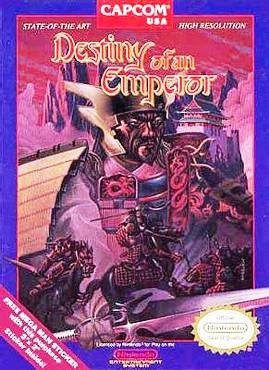
Destiny Of An Emperor

Friday, January 21, 2011

1 comments


I'm frequently swarmed with possibilities and kinda caught off guard when someone ever springs up the question "What is your favorite video game?" I can't help but want to side step the question, but where to begin? So many great selections from nearly each console, computer, and arcade generation. Though, on a recent phone interview I was able to respond both clear and intrinsically "Destiny Of An Emperor".  To give a little bit of context - I had never played D&D, had no concept of an RPG, let alone any knowledge of the Chinese Dynasty period drawn by Romance of The Three Kingdoms at age 10. This game hit the U.S. in 1989, before the western release of Final Fantasy and was also my first taste of turn-based, strategic combat.

The game's theme is really driven by its historical resurgence (which it deviates frequently) that makes for some epic story telling components like a cast of memorable abilities, weapons, and characters complete with a suspenseful narrative. Perhaps the best quality was the "accessibility" of the gameplay with an absence of unnecessary complexity, just a very well balanced experience that allowed enjoyment for learning a gamesystem that matches facing new challenges.  You persistently manage five generals that represent an army of soldiers - level up your generals = more soldiers which also requires managing "tacticians" who represent the ability casting element.  Though that game does lack some visual feedback in the form of particles during combat which would have really accented the immersion factor. Luckily that classic CAPCOM signature music picks up the slack for all the lose ends.

So why my favorite game of all time? Like a book Destiny Of An Emperor manages to streamline the imagination towards materializing something lager than life with such minimal presentation. The impression left behind was a grounding foundation for many games in the years to come. Know your roots!

Journey To Silius

Sunday, January 16, 2011

0 comments


Every so often I get those nostalgic 8-bit game music flashbacks that manage to relentlessly loop until that audio itch is scratched via Youtube. Journey To Silius probably had the most underrated NES game score ever conceived. Gameplay was your standard run and gun sidescroller, but the music was such a motivating component of the experience that it was simply a goal reaching other levels just to hear the next set of tunes. The tones a very comparable to the first stage of Double Dragon and even resonate some of the same energy of stages in Mega Man 2 including others in the Capcom library.

The selections above start with the title theme through the second stage (a personal favorite). Enjoy!

"The game was noted for unusually strong music (composed by Naoki Kodaka) for an 8-bit title. The NES DPCM channel was used for sampled bass tones, a choice which was unusual for NES compositions and lent the soundtrack a much thicker timbre.

The sound effects also showed up before in the past sunsoft games, specifically Blaster Master and Fester's Quest."

A Very Subjective Post Gameplay Rant

Wednesday, September 8, 2010

0 comments
A fellow game developer and good friend was kind enough to lend me a small surplus of games I had yet to test drive. Among those was Transformers - War For Cybertron, which was given a whirl since it had received fair critical reception. The game's level design and set pieces matched with a nice blend of scope, scale, and reverence to the original series, immediately sold the immersion factor for the first couple of hours of gameplay. In addition, tapering level flow included movers, ramps, catwalks, open vistas, narrow corridors, back and foreground elements added a sense of form and function to the game landscape - holy shit this is Cybertron - very satisfying spatial psychology! Then.... monotonous waves of NPC's rob the sense of virtual sensation from mastering an interesting game system. Thus, the challenge dulls creating a bit of immersion breakage. I suppose this is a choice between creating play options vs. developing complex AI (time constraints probably affected this). For contrast, it would have been nice to see a push towards integrating a few environmental puzzles or interactions especially with such great set pieces.


Transformers - War For Cybertron

Disappointingly, I had recently crossed this same path while playing God of War III . Design wise the game does not manage to retain quite the impact like the opening Mount Olympus sequence while small bugs like fidgety camera splines, a flawed rhythm based mini-game, and flat puzzling solving instances all contributed towards disappointing immersion breakage. I understand this title has an established design formula and is sticking to what it does best (hack and slash swarms of NPC's), but I can't help but expect something - a breath of fresh design ideas in this age of technological might. Though, the isometric Echochrome eqsque sequence was a noble attempt in that direction! However, the game did manage to nail the story telling components every step of the way - a very signature trait of this franchise. I had to ask myself "is this a masterpiece or game of the year material?" My expectations were riding high on this one.

God of War 3

While Playing Limbo it became evident how to compare and contrast between the overall experience from the aforementioned titles. Though it may not be suitable to compare apples to oranges, but the point I'm trying to etch is that a well established intellectual property is clearly not a means towards neglecting potential new aspects of your current design architecture (no deep wisdom there). Using various nuances to leverage mechanics and objectives can be an ideal solution towards straying from dull monotony. Good level design exposes subsets of a system which, can be easily added up to help forge gameplay cohesion. Little Big Planet succeeded quite well in that respect- a variety physics based problem solving adds character to puzzles while allowing spaces to feel less static which implies organic spatial relationships. In turn, these types of characteristics begin to embody the essence of game design cohesion, fluidity, harmony, and balance that create an arch of mastery fit for improvising. When these elements gracefully fall into place the game ignites that nerve, an emotional surge of ownership.

Limbo

The wife and I enjoyed Limbo because of its ability to promote thought provoking problem solving through mood, timing, contrast, and foreshadowing. These traits also applied towards the the gray-scale visual language which add an additional layer of wonder and awe to the mood category which summons that emotional intimacy you hope for in most interactive experiences. Oh yeah, and the game manages to exploit dark humor through dying in a variety of ways. Design wise the game demands learning through failure, often times repetitively which can almost be closely tied into a game like Portal.

So... sure button mashing and relentless poundings of NPC's can have its merits too. I'm a firm believer in having a healthy blend of content for any type of occasion, mood, or curiosity. Surly one does not eat the same kind of food, read the same kind of books, or watch the same movies everyday- do they?

Visual Music Collaborative 2010

0 comments
More food for gaming thought. The overlap of interactive music/sound based apps continues to find itself gravitating towards game design architecture. This five day workshop at the Eyebeam art and technology collective in New York was held in collaboration with Ghostly International as a means to explore visual-musical experiences. These explorations are intended to create a "framework" that could perhaps be built upon in future instances.


Visual Music Collaborative 2010 from Aaron Meyers on Vimeo.

Sougwen - Drawing Jam

0 comments
I happened to stumble across the work of illustrator, Sougwen through a retweet several weeks ago. Her work is quite remarkable and lends itself toward very conceptual and organic forms that would be ideal for translating over to some sort of interactive experience. I'm currently exploring a design treatment for a psychological-therapeutic app. that allows some exercise of self expression wrapped in a seamless, fluid manner. Needless to say watching this segment does wonders for the imagination.


Sepalcure - Every Day of my Life from sougwen on Vimeo.